News & Events
Industrial Visit to Pachaiyappas Silks
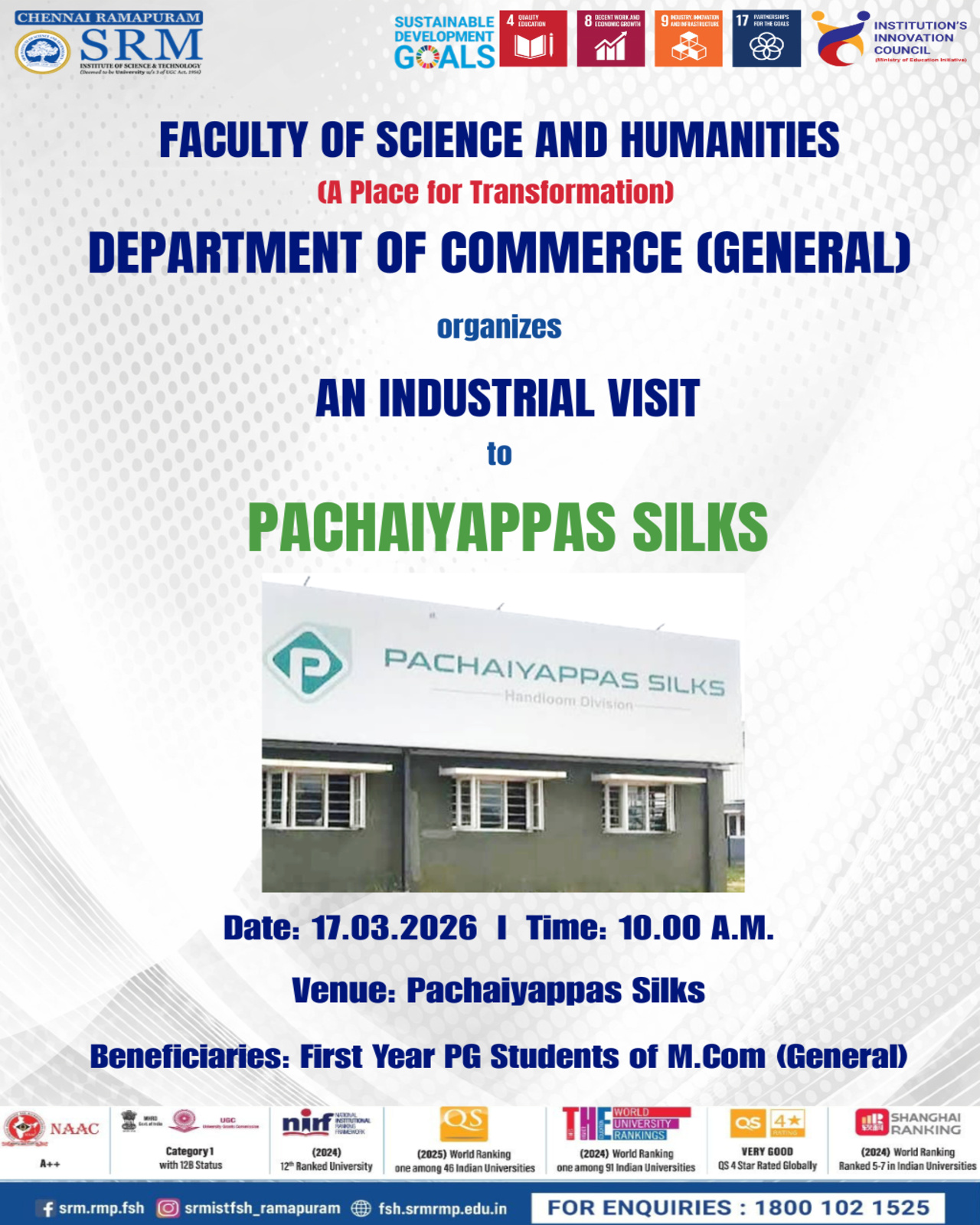
DEPARTMENT OF COMMERCE
Organizes
AN INDUSTRIAL VISIT
To
PACHAIYAPPAS SILKS
Date: 24.07.2025 │Time: 10.00 A.M.
Venue: Pachaiyappas Silks
Beneficiaries: First Year PG Students of M. Com (General)
Convenors
Dr. S. Sakthi, Assistant Professor
Dr. P. Maheswari, Assistant Professor
Objective of the Event
The objective of the industrial visit to Pachaiyappa’s Silks is to provide students with practical exposure to the functioning of the silk textile industry and to bridge the gap between theoretical knowledge and real-world applications. The visit aims to help students understand the complete production process, from raw material procurement to the final finished products, while also familiarizing them with both traditional and modern weaving techniques. It enables students to observe quality control measures, organizational structure, and workflow within the enterprise. Additionally, the visit offers insights into supply chain management, marketing strategies, and customer engagement practices adopted by the organization. It also seeks to enhance students’ analytical, observational, and communication skills, while creating awareness about entrepreneurship opportunities and the significant role of the textile industry in economic development and employment generation.
Summary of The Event
The Department of Commerce, Faculty of Liberal Arts and Business Studies, SRM Institute of Science and Technology, Ramapuram, organized an Industrial Visit to Pachaiyappa’s Silks as part of experiential learning to enhance students’ practical exposure to the textile industry. The visit was conducted from 10:00 AM to 3:00 PM, on 17th March 2026. providing students with an opportunity to understand the real-time functioning of a silk manufacturing and retail enterprise.
The primary objective of the visit was to familiarize students with the complete production process of silk textiles, including raw material handling, weaving techniques, finishing processes, and quality control measures. The visit aimed to bridge the gap between theoretical knowledge and industrial practices, while also offering insights into supply chain management, marketing strategies, and customer engagement in the textile sector.
During the visit, students were guided through different sections of the organization, where industry experts explained both traditional and modern techniques used in silk production. Emphasis was placed on the importance of maintaining quality standards, adapting to changing market trends, and integrating innovation within the production process. Students also gained knowledge about the organizational structure and operational workflow of the enterprise.
The session was interactive, allowing students to engage with professionals, clarify their doubts, and understand practical challenges faced in the industry. This hands-on exposure helped in enhancing their analytical thinking, observational skills, and understanding of real-world business operations.
This industrial visit contributed to the achievement of Sustainable Development Goals (SDGs) such as SDG 4 (Quality Education), SDG 8 (Decent Work and Economic Growth), SDG 9 (Industry, Innovation and Infrastructure), and SDG 17 (Partnerships for the Goals) by promoting skill-based learning, industrial awareness, innovation, and collaboration between academic institutions and industry.
Overall, the industrial visit proved to be an enriching and insightful experience, enabling students to connect classroom learning with practical applications while preparing them to meet the demands of the professional world with greater confidence and competence.
Outcome of the Event
SDG 4: Quality Education
The industrial visit promoted experiential learning by exposing students to real-time industrial processes in the textile sector. It helped bridge the gap between theory and practice through direct observation and interaction. Students developed a better understanding of production, quality control, and business operations. This enhanced their critical thinking, practical knowledge, and overall academic learning experience.
SDG 8: Decent Work and Economic Growth
The visit provided insights into employment opportunities and workplace practices within the textile industry. Students learned about the skills and competencies required for various roles in the sector. It also highlighted the contribution of the textile industry to economic growth and job creation. This exposure improved students’ career awareness and employability readiness.
SDG 9: Industry, Innovation, and Infrastructure
Students were introduced to both traditional and modern techniques used in silk production. The visit emphasized the role of innovation and technology in improving productivity and maintaining quality standards. It helped students understand how industries adapt to changing market demands. This encouraged them to think about innovation-driven solutions in business and production.
SDG 17: Partnerships for the Goals
The industrial visit strengthened the relationship between academia and industry through active collaboration. Students benefited from direct interaction with industry professionals and practical knowledge sharing. Such partnerships enhance learning opportunities and professional exposure. It also supports sustainable development through cooperation and mutual exchange of expertise.