
News & Events
Business Management - UCM24102J
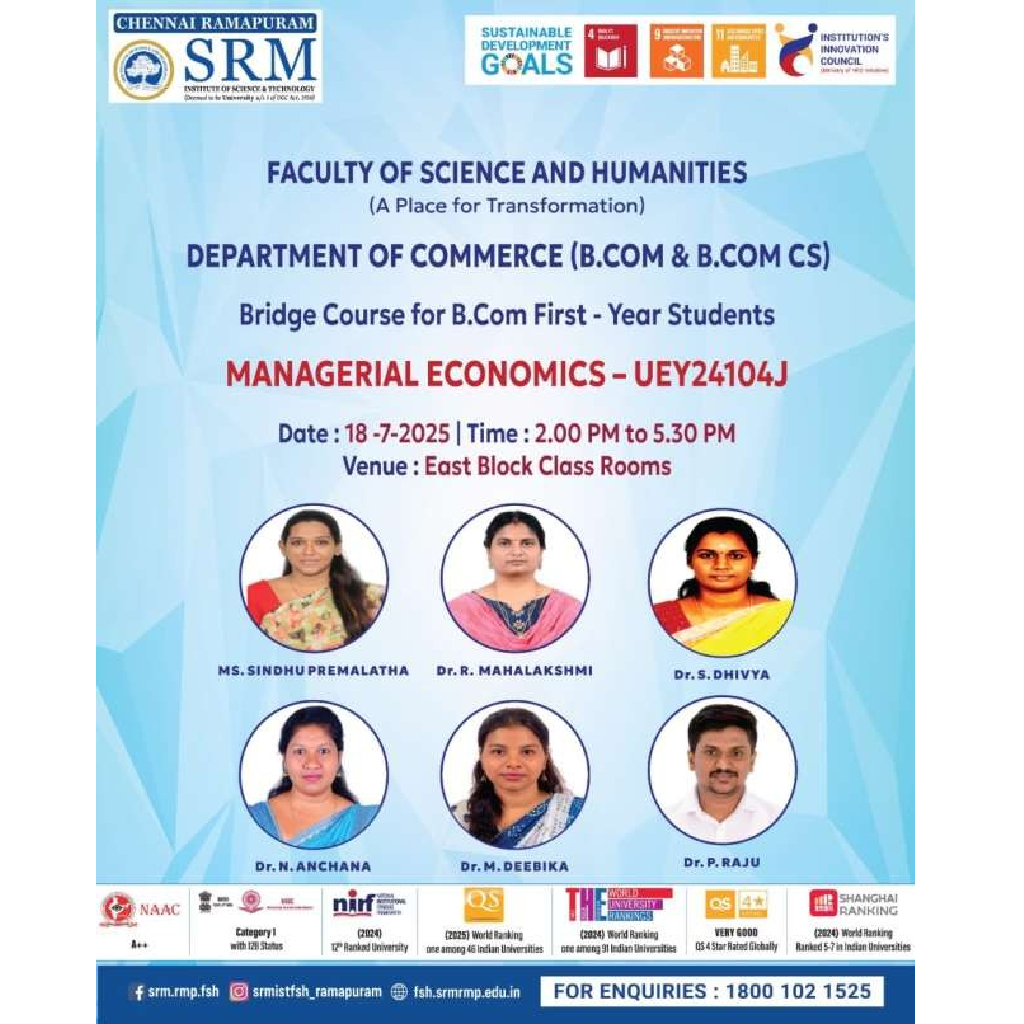
Title of the Event:“Bridge Course for B.Com First-Year Students” Topics “Business Management - UCM24102J”
Date:18.07.2025
Time:2.00 p.m To 5.30 p.m
Venue:East block Smart Room 203 & 204
Total Attendees:110
Resource Persons
- Ms. SindhuPremalatha
- Dr. R. Mahalakshmi
- Dr S. Dhivya
- Dr.N. Anchana
- Dr.M.Deebika
- Dr.P.Raju
Profile of the Speakers
Ms. SindhuPremalatha – Assistant Professor Dr. R. Mahalakshmi – Assistant Professor Dr S. Dhivya – Assistant Professor
Dr.N. Anchana – Assistant Professor Dr.M.Deebika – Assistant Professor Dr.P.Raju – Assistant Professor
Event Mode:Off line
Incharges:
Convenor:Dr. J. Kumar – Associate Professor & Head, Department of Commerce
Coordinators:
Dr.S.Mani – Assistant Professor Dr. J. Kumar – Associate Professor Dr.P.Raju – Assistant Professor
Objective of the Event
The Bridge Course was organized for first-year B.Com students with the objective of providing a foundational understanding of Managerial Economics (UEY24104J). The course aimed to bridge the knowledge gap and ease the transition into core subject areas; ensuring students e well-preparedtocomprehend complex economic concepts and their applications in the business environment.
RESOURCE PERSONS:
Ms. SindhuPremalatha – Assistant Professor Dr. R. Mahalakshmi – Assistant Professor Dr. S. Dhivya – Assistant Professor
Dr. N. Anchana – Assistant Professor Dr. M.Deebika – Assistant Professor Dr. P.Raju – Assistant Professor
SUMMARY OF THE EVENT
Dr. S. Mani Assistant Professor, welcomed the Resource Persons and The event featured a series of expert-led sessions delivered by experienced faculty members, covering various key aspects of managerial economics. Each session was designed to provide conceptual clarity and practical relevance to students.
Overview of Sessions & Speakers:
1. Ms. Sindhu Premalatha – Assistant Professor
Topic: Effective Decision Making & Strategy Approach
Time: 2:00 PM – 2:30 PM
Ms. SindhuPremalatha kickstarted the program with a session focused on the strategic approaches to decision-making. She explained the role of economic tools and rational thinking in managerial decision-making. Her session emphasized analytical models like SWOT and decision trees used in strategic business contexts.
2. Dr. R. Mahalakshmi – Assistant Professor Topic: Business and Economic Environment Time: 2:30 PM – 3:00 PM
Dr. Mahalakshmi provided an in-depth look at the external business environment, highlighting economic indicators, government policies, and global influences. She helped students understand the importance of adapting business strategies to shifting economic conditions.
3. Dr. S. Dhivya – Assistant Professor
Topic: Fundamental Economics: Decision Making and Cost-Benefit Analysis
Time: 3:00 PM – 3:30 PM
Dr. Dhivya’s session delved into the basics of economic reasoning, cost-benefit analysis, and opportunity cost. Her engaging examples gave students clarity on how economic logic is applied to everyday business decisions.
4. Dr. N. Anchana – Assistant Professor Topic: Basic Economic Problems Time: 4:00 PM – 4:30 PM
Dr. Anchana discussed the fundamental economic problems of scarcity, choice, and allocation. Her presentation drew connections between classical economic problems and contemporary business practices.
5. Dr. M. Deebika – Assistant Professor
Topic: Business Decision-Making through Economic Analysis
Time: 4:30 PM – 5:00 PM
Dr. Deebika focused on demand analysis, cost structures, and pricing strategies. Her session demonstrated how businesses use economic principles to drive profitability and sustainability.
6. Dr. P. Raju – Assistant Professor
Topic: Recent Trends in Managerial Economics
Time: 5:00 PM – 5:30 PM
Dr. Raju concluded the event with a forward-looking session on current and emerging trends in the field, including digital transformation, behavioral economics, and AI in business decision-making.
TARGET AUDIENCE
The program was attended by all first-year undergraduate students of the Commerce Department, who displayed keen interest and active participation throughout the sessions.
CONCLUSION
The Bridge Course successfully achieved its goal of preparing students with essential knowledge in Managerial Economics. The sessions were well-structured, informative, and engaging. Feedback from students indicated that the program was valuable in laying a strong academic foundation as they embark on their B.Com journey.
VOTE OF THANKS
Dr. P. Raju Assistant Professor coordinated the interactive session that followed the speaker's address. The session concluded with a vote of thanks, and positive feedback was received from the students, making the event a successful and knowledge-sharing sessions that ignite curiosity and foster academic excellence among our students.
LINK SHARING:
https://www.instagram.com/p/DMM68xzzgAX/?igsh=N3FtNmVrOXNwNGJj
OUTCOME OF THE PROGRAM:
SDG 4: Quality Education
By cultivating these daily habits, individuals can significantly contribute to SDG 4, which aims to ensure inclusive and equitable quality education and promote lifelong learning opportunities for all. The habits outlined above not only enhance personal productivity but also encourage a lifelong commitment to learning, self-improvement, and skill development.
- Improved Knowledge and Skill Acquisition: Regular learning habits support a deeper understanding of subjects and enhance your ability to apply knowledge effectively in real-world situations.
- Increased Motivation for Lifelong Learning: A focus on continuous learning, reflection, and goal-setting nurtures intrinsic motivation, making education an ongoing part of life.
- Enhanced Personal and Professional Growth: Consistent educational habits contribute to the development of skills that are relevant for both personal development and career advancement, aligning with the broader goals of SDG 4.
- Access to Equitable Opportunities: Developing strong educational habits and skills can empower individuals to seek and utilize educational resources, thus fostering greater access to opportunities for themselves and their communities.
SDG 09:infrastructure, promoting inclusive and sustainable industrialization,
SDG 9 focuses on building resilient infrastructure, promoting inclusive and sustainable industrialization, and fostering innovation. It aims to improve infrastructure, boost industrialization, and encourage innovation to drive economic growth and improve living standards.
Key aspects of SDG 9:
- Resilient Infrastructure:This includes developing and upgrading reliable and sustainable infrastructure such as transportation, energy, and information and communication technology (ICT).
- Sustainable Industrialization:It emphasizes the need for inclusive and sustainable industrial development to drive economic growth, create jobs, and improve living standards.
- Innovation:This aspect focuses on fostering innovation in industrial sectors, promoting technological advancements, and developing new skills.
- Investment in Research and Development:SDG 9 encourages investment in research and development, which is crucial for driving innovation and technological progress.
Resource Efficiency:The goal also promotes increased resource use efficiency and the adoption of clean and environmentally sound technologies and industrial processes.
SDG 11: Sustainable Cities and Communities
By incorporating these daily habits, individuals can contribute to the broader goals of SDG 11, which aims to make cities and communities safer, more resilient, and sustainable. These actions, when practiced consistently, create more livable environments for everyone, fostering long-term motivation, productivity, and well-being.
- Reduced Environmental Impact: By adopting sustainable habits like using public transport, reducing waste, and conserving energy, individuals contribute to lowering pollution, reducing carbon emissions, and preserving natural resources in urban areas.
- Stronger, More Resilient Communities: Healthy habits that focus on social interaction, community engagement, and collective action strengthen the social fabric of cities, making them more inclusive and resilient in the face of challenges.
- Healthier Urban Environments: Regular interaction with green spaces, healthy living, and a focus on mental well-being help create a balanced and livable urban environment, promoting both physical and emotional health.
- Sustained Motivation and Productivity: Sustainable habits like prioritizing well-being, managing stress, and maintaining a healthy lifestyle not only enhance individual productivity but also contribute to a higher quality of life, making it easier for people to engage with and contribute to their communities.