
News & Events
Figured Motif Creation and Its Arrangement for Printing and Weaving
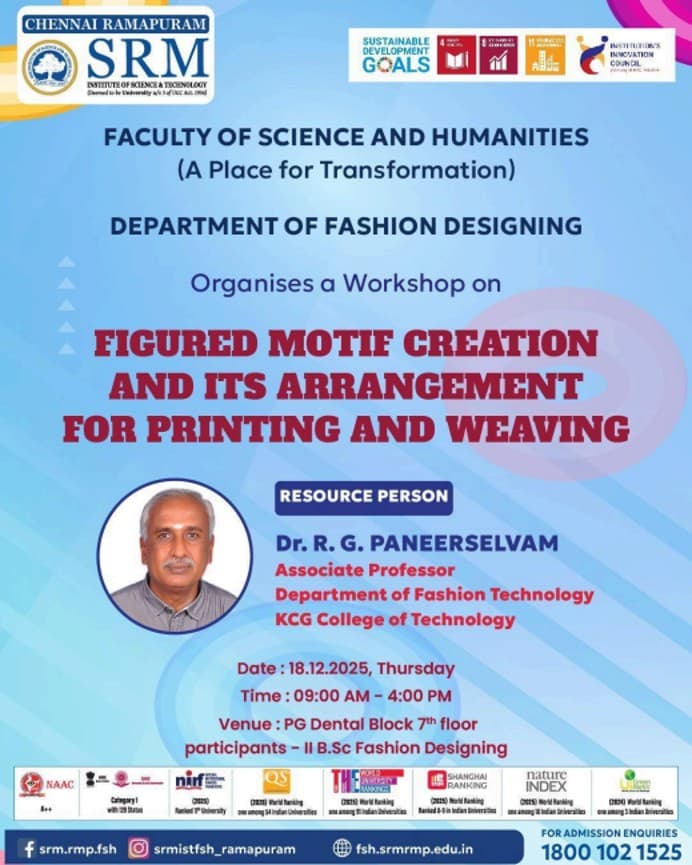
DATE: 18.12.2025
TIME : 08.00 am – 04.00 pm
VENUE : Room No: 704, BMS Block
EVENT CONVENER:
Dr. V. Bhanu Rekha Head of the Department, Fashion Designing
EVENT COORDINATORS:
Ms. Oviya Yuvashree, Mr. J. Sathya Narayanan, AP, Fashion Designing
Resource Person:
Dr. R. G. Panneerselvam, Associate Professor, Department of Fashion Technology, KCT College of, Chennai Technology.
SUMMARY OF THE EVENT:
A one-day workshop titled “Figured Motif Creation and Its Arrangement for Printing and Weaving” was successfully conducted by the Department of Fashion Technology. The workshop primarily focused on design creation in textiles, with special emphasis on the conceptual and practical aspects of motif development.
The objective of the workshop was to enhance students’ understanding of figured motif creation, its aesthetic principles, and its application in textile printing and weaving. Dr.
Panneerselvam began the session by explaining the fundamentals of motifs, including their historical significance, types, and relevance in traditional and contemporary textiles.
He highlighted how motifs serve as a core element in surface design and fabric aesthetics.
The workshop further emphasized motif arrangement techniques, such as repeat patterns, symmetry, balance, and proportion. Participants were introduced to various layout methods suitable for printing and weaving processes. Through interactive discussions and demonstrations, the resource person explained how design considerations vary based on end-use, fabric structure, and production techniques.
A hands-on session formed the key component of the workshop, where students actively engaged in creating original figured motifs and experimenting with different arrangements. This practical exposure enabled participants to translate theoretical concepts into creative textile designs. Students were encouraged to explore innovation while maintaining functionality and design harmony.
The workshop concluded with a feedback and interaction session, during which students clarified their doubts and shared their learning experiences. Overall, the workshop proved to be highly informative and enriching, enhancing the participants’ creative skills and technical knowledge in textile design. The program successfully met its objectives by fostering creativity, design thinking, and a deeper appreciation for motif creation in printing and weaving applications.
Key Takeaways of the Workshop Gained a comprehensive understanding of figured motif creation and its significance in textile design for printing and weaving.
Learned various motif arrangement techniques such as repeat patterns, symmetry, balance, and layout planning.
Developed practical skills in design conceptualization and visualization for different textile applications.
Enhanced creative thinking and design innovation while maintaining functionality and aesthetic harmony.
Understood the relationship between traditional motifs and contemporary textile design practices.
Improved hands-on experience through practical exercises, strengthening industry- relevant design competencies Encouraged awareness of sustainable and culturally rooted design approaches in textiles.
OUTCOMES OF THE PROGRAM: (Based on SDG) SDG 4 – Quality Education The workshop provided experiential and skill-based learning, bridging the gap between theory and practice.
Enhanced students’ technical knowledge and creative abilities in textile design.
Promoted lifelong learning by exposing students to industry-oriented design methodologies.
Encouraged critical thinking, creativity, and problem-solving skills essential for academic and professional growth.
SDG 8 – Decent Work and Economic Growth Equipped students with employability-focused design skills relevant to the textile, apparel, and handloom sectors.
Supported skill development for future designers and entrepreneurs, contributing to sustainable livelihoods.
Encouraged innovation in textile design that can enhance value addition and economic opportunities.
Strengthened the connection between education and the creative economy.
SDG 11 – Sustainable Cities and Communities Promoted the use of traditional and culturally inspired motifs, supporting the preservation of textile heritage.
Encouraged responsible and sustainable design practices aligned with local craftsmanship and cultural identity.
Fostered appreciation for heritage-based textile design, contributing to culturally resilient communities.
Supported sustainable urban and community development through design-led cultural expression.
Images: 1 · 2 · 3 The Designer Runway’26