News & Events
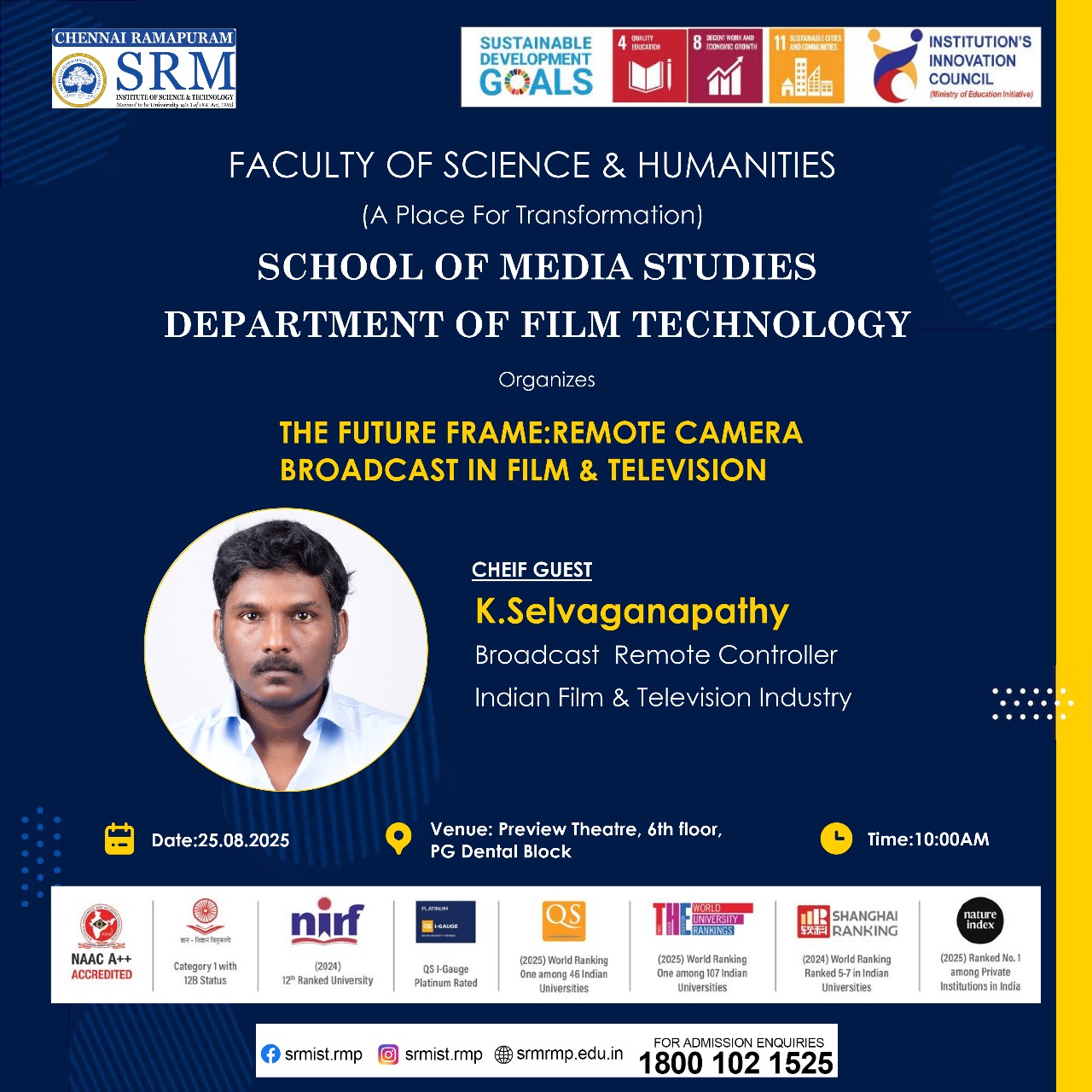
The Future Frame :REMOTE CAMERA BROADCAST IN FILM & TELEVISION
SUMMARY OF THE EVENT:
The Department of Film Technology, under the School of Media Studies at SRM Institute of Science & Technology, Chennai Ramapuram, successfully organized an enlightening and industry-relevant event titled “THE FUTURE FRAME: REMOTE CAMERA BROADCAST IN FILM & TELEVISION” on 25th August 2025. The event was aimed at bridging the gap between academic learning and industry practices by introducing students to the latest technologies and innovations in remote camera broadcasting for film and television.
The session began at 10:00 AM at the Preview Theatre, located on the 6th floor of the PG Dental Block.
Objective of the Event
The initiative was designed to:
• Equip students with knowledge of remote camera broadcasting technology.
• Provide exposure to PCR (Production Control Room) and MCR (Master Control Room) operations.
• Demonstrate multi-camera console setups used in popular reality shows.
• Introduce Sony BRC camera functionalities and broadcasting workflows.
• Highlight industry practices in lighting, post-production, and digital imaging.
Event Proceedings
Welcome Address
The event commenced with a welcome address by the Head of the Department of Media Studies. In the speech, the HOD emphasized the need for students to stay up-to-date with rapid technological advances in the media industry and how such initiatives contribute to skill-building and industry readiness.
Session Highlights
The main content of the session revolved around in-depth demonstrations and interactive discussions on:
• Remote Camera Operations used in live television and reality shows.
• Functioning of PCR and MCR, highlighting the roles of each during a live or recorded telecast.
• Introduction to multi-camera console operations using practical examples from popular television programs such as Bigg Boss and Cook with Comali.
• Use and configuration of Sony BRC cameras, commonly used for remote-controlled shooting in professional environments.
• Insights into broadcast lighting techniques, basic to advanced post-production processes, and digital imaging technologies.
Industry professionals and faculty from the Film Technology department conducted the sessions, sharing real-world examples and encouraging interactive student participation.
Special Address and Memento Presentation
A special segment was held during which the Vice Principal of SRM Institute of Science & Technology presented a memento to the Chief Guest, acknowledging their valuable presence and contribution to the event.
Vote of Thanks
The session concluded with a Vote of Thanks delivered by the Program Coordinator, who expressed gratitude to the management, faculty, students, and guests for their enthusiastic participation and support. Appreciation was extended to the technical team and organizing committee for their seamless execution of the event.
Participants
The event was attended by:
• Students of Film Technology
• Faculty members
Outcome of the Program
The “Future Frame: Remote Camera Broadcast in Film & Television” event achieved its intended objectives and delivered measurable outcomes that significantly benefitted the participating students and faculty. The key outcomes are as follows:
1. Enhanced Industry Readiness:
Students gained practical exposure to real-world broadcast operations, making them more confident and better prepared for careers in television production and digital broadcasting.
2. Hands-on Technical Knowledge:
Participants acquired first-hand understanding of working with:
o Sony BRC cameras
o Multi-camera setups
o PCR (Production Control Room) and MCR (Master Control Room) operations
These are critical technologies used in live and reality TV productions.
3. Awareness of Professional Workflows:
Students learned how major reality shows like Bigg Boss and Cook with Comali are executed using multi-camera broadcasting, including the coordination between camera teams, directors, and technical crews.
4. Understanding of Integrated Production Systems:
The session provided insights into the full production pipeline — from camera operation to lighting, post-production, and digital imaging, offering a holistic view of how television content is created and broadcast.
5. Faculty Development:
Faculty members also benefited from the session by updating their knowledge on emerging technologies and methodologies, which they can incorporate into academic delivery.
6. Increased Student Engagement and Interest:
The interactive nature of the event, including live demonstrations and Q&A sessions, sparked curiosity among students and encouraged many to pursue further learning in advanced broadcast technology and production.
7. Networking Opportunities:
Students and faculty had opportunities to interact with industry professionals, laying the foundation for future internships, collaborations, and guest lectures.