
News & Events
Next-Gen Cybersecurity & Ethical Hacking
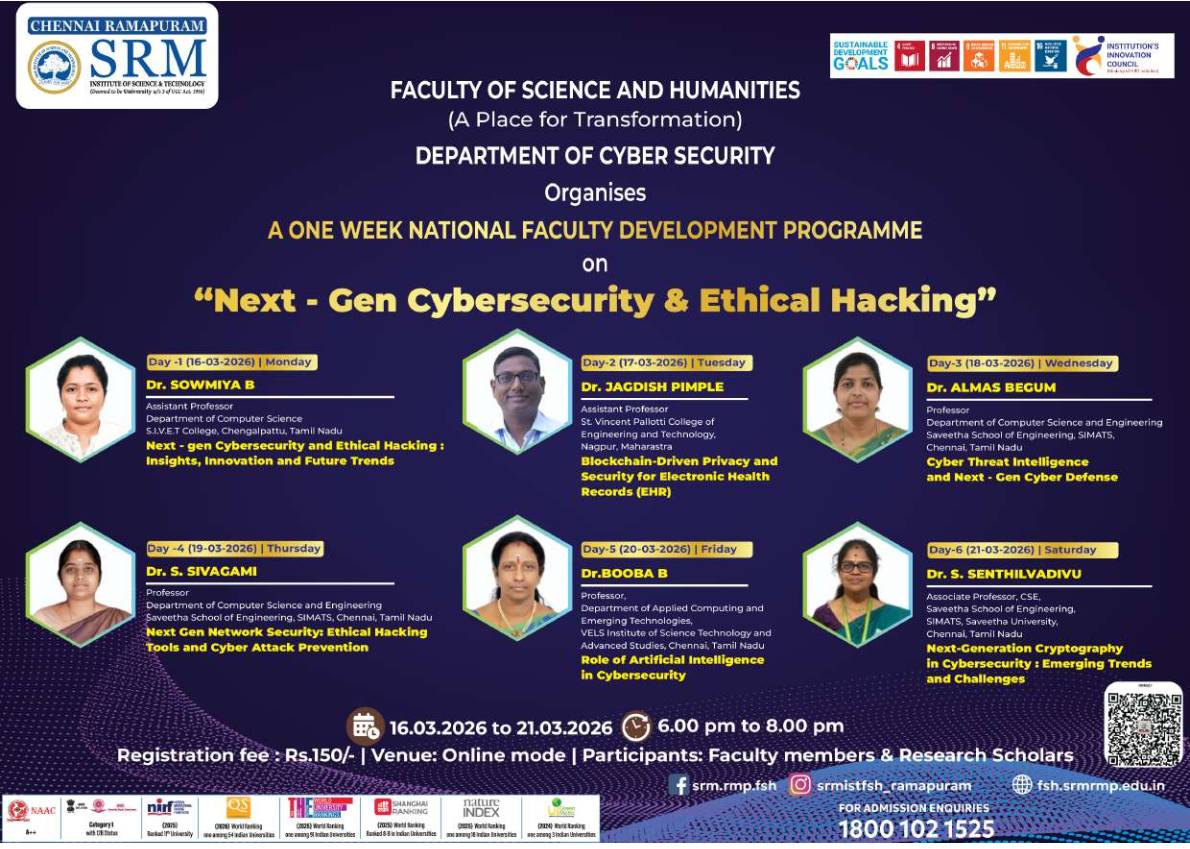
EVENT TITLE: One Week National FDP on “Next-Gen Cybersecurity & Ethical Hacking”
DATE: 16/03/2026 (Monday) to 21/03/2026 (Saturday)
TIME: 06:00 pm to 08:00 pm
VENUE/MODE: Online
EVENT COORDINATORS: Mrs. T. Kanimozhi, Assistant Professor, Mrs. P. Renuka, Assistant Professor
EVENT CONVENER: Dr. J. Jebamalar Tamilselvi, HoD / CS with Specialization in Cyber Security
SUMMARY OF THE EVENT
The Department of Cyber Security successfully organized a one-week National Faculty Development Programme on “Next – Gen Cybersecurity & Ethical Hacking”.
Day 1:
The first day of the FDP was led by Dr. B. Sowmiya, Assistant Professor, Department of Computer Science, S.I.V.E.T College, Chengalpattu. She gave a talk on “Next – Gen Cybersecurity and Ethical Hacking: Insights, Innovation and Future Trends”. Her information was highly informative, engaging, and relevant to the rapidly evolving digital landscape. It effectively highlighted the growing importance of cybersecurity and the proactive role of ethical hacking in identifying and mitigating cyber threats.
Day 2:
Dr. Jagdish Pimple, Assistant Professor, St. Vincent Pallotti College of Engineering and Technology, Nagpur, Maharastra was the resource person for the second day of the One Week FDP. His lecture was on “Blockchain-Driven Privacy and Security for Electronic Health Records (HER). His topic presents a highly relevant and emerging solution to critical healthcare challenges. Integrating blockchain with Electronic Health Records (EHR) effectively addresses data privacy, security, and interoperability issues, making it a strong and impactful research area.
Day 3:
The resource person for the third day of the FDP was Dr. Almas Begum, Professor,
Department of Computer Science and Engineering, Saveetha School of Engineering, SIMATS, Chennai. Her presentation was on the topic Cyber Threat Intelligence and Next – Gen Cyber Defense. The session was highly beneficial and enhanced my knowledge of modern cybersecurity practices. It emphasized the importance of proactive defense, intelligence-driven security, and the integration of advanced technologies in combating cyber threats.
Day 4:
The fourth day of the faculty development programme was led by Dr. S. Sivagami, Professor, Department of Computer Science and Engineering, Saveetha School of Engineering, SIMATS, Chennai. Her session on “Next-Gen Network Security: Ethical Hacking Tools and Cyber Attack Prevention” was highly informative and relevant in today’s rapidly evolving digital landscape. It effectively highlighted the importance of proactive security measures and demonstrated how ethical hacking plays a crucial role in identifying vulnerabilities before malicious attackers exploit them. Her session was insightful and impactful. It successfully emphasized the need for next-generation security solutions and showcased how ethical hacking tools can be used responsibly to prevent cyberattacks. The knowledge gained from this session is valuable for students and professionals aiming to build careers in cybersecurity.
Day 5:
Dr. B. Booba was the resource person for the fifth day of the one-week national faculty development programme. She gave her talk on “Role of Artificial Intelligence in Cybersecurity”. Her presentation effectively highlighted how AI techniques such as Machine Learning and deep learning help in threat detection, anomaly detection, and real-time response. The explanation of automated security systems and predictive analysis demonstrated a strong understanding of how AI enhances the efficiency and accuracy of cybersecurity measures. The inclusion of real-world applications, such as fraud detection, intrusion detection systems, and malware analysis, made the discussion more practical and engaging.
Day 6:
Dr. S. Senthillvadivu, Associate Professor, CSE, Saveetha School of Engineering, Simats, Saveetha University, Chennai, was the resource person on the sixth day of the faculty development programme. She delivered her speech on “Next – Generation Cryptography in Cybersecurity: Emerging Trends and Challenges”. The topic Next-Generation Cryptography in Cybersecurity is highly relevant and forward-looking. She effectively addresses the transformation of cryptographic systems in response to emerging technologies like quantum computing, artificial intelligence, and distributed systems. The presentation demonstrates strong awareness of current cybersecurity risks and future-proof security mechanisms.
Key Takeaways
- Traditional security methods are no longer sufficient due to advanced threats like AI-driven attacks, ransomware, and zero-day exploits.
- Ethical hackers play a critical role in identifying vulnerabilities before malicious attackers can exploit them.
- Organizations are moving from reactive defence to proactive threat detection and prevention using advanced tools and strategies.
- Trust no user or system by default—continuous verification is becoming a core security principle.
- Artificial Intelligence is being used for real-time threat detection, anomaly detection, and automated response systems.
- As cloud computing and IoT devices grow, securing distributed systems becomes more complex and crucial.
- Regular penetration testing helps simulate real-world attacks and strengthen system defences.
- There is a high demand for cybersecurity experts and ethical hackers in industries worldwide.
- Ethical hacking must always follow legal frameworks, permissions, and professional codes of conduct.
- Cyber threats evolve constantly, so staying updated with new tools, techniques, and certifications is critical.
OUTCOMES OF THE PROGRAM: (Based on SDG)
SDG 4 (Quality Education): The students were able to gain knowledge on 1) Protecting critical infrastructure, 2) Securing renewable energy systems, 3) Preventing environmental damage, and 4) Advancing social inclusion through digital access.
SDG 8 (Decent Work and Economic Growth): Promotes inclusive and sustainable economic growth by encouraging productive employment and decent work for all. The goal also supports entrepreneurship, innovation, and skill development to reduce unemployment and poverty.
SDG 9 (Industry, Innovation and Infrastructure): The discussion emphasized that resilient infrastructure, sustainable industrialization, and innovation cannot be achieved without a strong cybersecurity foundation
SDG 11 (Sustainable Cities and Communities): The event encouraged students to understand how cybersecurity plays a crucial role in protecting the digital infrastructure that supports essential services, public safety, and efficient urban management.
SDG 16 (Sustainable Development Goal) is one of the 17 global goals established by the United Nations under the 2030 Agenda for Sustainable Development. It focuses on promoting peaceful and inclusive societies, ensuring access to justice for all, and building effective, accountable, and inclusive institutions.