News & Events
Knowledge Enrichment Program for Teaching and Non- Teaching Faculty- “Hand Embroidery”
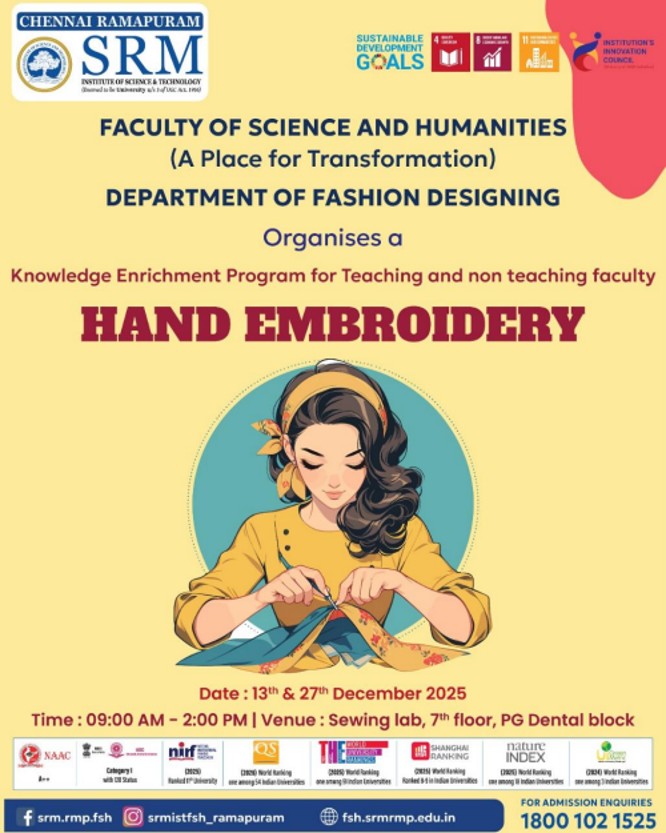
EVENT TITLE : Knowledge Enrichment Program for Teaching and Non- Teaching Faculty- “Hand Embroidery”
DATE : 13.12.25 & 27.12.2025
TIME : 9.00 AM to 2.00 PM
EVENT CONVENER:
Dr. V. Bhanu Rekha
Head of the Department, Fashion Designing
EVENT COORDINATORS:
N. Gayathri and M. Rampriya,
AP, Fashion Designing
RESOURCE PERSON:
Ms. Gayathri and Ms. M. Rampriya, Assistant professors – Department of Fashion Designing.
SUMMARY OF THE EVENT:
The Department of Fashion Designing, Faculty of Liberal Arts and Business Studies, SRM Institute of Science and Technology, Ramapuram, successfully organized a Knowledge Enrichment Program for Teaching and Non-Teaching Faculty titled “HAND EMBROIDERY” on 13th and 27th December 2025, from 9:00 AM to 2:00 PM, at the Sewing Lab, 7th Floor, PG Dental Block.
The program was designed to enrich participants with traditional hand embroidery skills, emphasizing creativity, craftsmanship, and sustainability. Faculty members from teaching and non-teaching streams actively participated, making the program interdisciplinary and inclusive. The sessions blended theoretical understanding with hands-on practice, enabling participants to experience embroidery as both an art form and a sustainable skill.
Both resource persons brought strong academic expertise and practical knowledge in textile crafts and fashion design, ensuring a well-structured and engaging learning experience for all participants. Their approach seamlessly integrated theoretical concepts with hands-on training, making the sessions informative, interactive, and outcome-oriented.
SEMINAR HIGHLIGHTS AND KEY POINTS
- Introduction to hand embroidery as a heritage craft and its relevance in contemporary fashion.
- Demonstration of basic and decorative embroidery stitches suitable for garments and accessories.
- Hands-on practice sessions encouraging experiential learning.
- Discussion on sustainable fashion practices through hand-crafted techniques.
- Emphasis on slow fashion, zero-waste concepts, and eco-friendly design approaches.
- Interactive engagement that promoted skill-sharing, creativity, and teamwork.
- Exposure to embroidery as a value-added skill for both personal and professional growth.
Impact of the Resource Persons
Together, Ms. Gayathri and Ms. M. Rampriya created a supportive and inspiring learning environment. Their interactive teaching methods encouraged active participation, creativity, and peer learning among both teaching and non-teaching faculty.
- Enhanced skill-based learning among teaching and non-teaching faculty.
- Promoted awareness of traditional crafts and cultural preservation.
- Encouraged creative expression and stress reduction through hands-on activity.
SUSTAINABLE DEVELOPMENT AND GROWTH MAPPING
The program strongly aligned with the following Sustainable Development Goals (SDGs):
SDG 4 – Quality Education
The programme strongly supported SDG 4 by promoting skill-based, experiential learning beyond conventional classroom teaching. Participants were provided with hands-on training in hand embroidery techniques, enabling them to acquire practical competencies, creativity, and craftsmanship. The initiative fostered lifelong learning by encouraging continuous skill upgradation, self-learning, and knowledge transfer. It also enhanced educational inclusivity by making traditional craft education accessible to both teaching and non-teaching faculty, thereby broadening learning opportunities and strengthening vocational education within the academic ecosystem.
SDG 8 – Decent Work and Economic Growth
In alignment with SDG 8, the programme highlighted hand embroidery as a viable income-generating skill that can support self-employment, home-based work, and micro entrepreneurship. By introducing participants to the economic potential of handcrafted products, the initiative encouraged dignified, skill-oriented employment rooted in traditional craftsmanship. It emphasized how embroidery skills can contribute to small-scale enterprises, freelancing, and sustainable livelihoods, particularly benefiting women artisans and creative professionals, while supporting local economies and inclusive economic growth.
SDG 11 – Sustainable Cities and Communities
The programme contributed to SDG 11 by encouraging the preservation and revival of traditional textile crafts, which form an integral part of cultural heritage. Through awareness and skill transmission, the initiative helped sustain intangible cultural assets such as regional embroidery styles and indigenous design knowledge. By valuing handcrafted techniques over mass-produced alternatives, the programme strengthened community identity, cultural continuity, and heritage conservation, fostering resilient and culturally vibrant communities.
SDG 12 – Responsible Consumption and Production
In support of SDG 12, the programme advocated sustainable fashion practices by promoting hand embroidery as a low-energy, low-waste, and environmentally responsible production method. Participants were sensitized to the benefits of slow fashion, ethical consumption, and the use of handcrafted embellishments that minimize environmental impact.
The initiative emphasized responsible production by encouraging quality craftsmanship, durability, and mindful consumption, thereby reducing dependence on fast fashion and supporting sustainable design and production systems.
OUTCOMES OF THE PROGRAM (BASED ON SDG AND FEEDBACK)
Participants reported improved understanding of sustainable fashion practices.
Increased interest in handcrafted and eco-friendly design techniques.
Positive feedback on the hands-on learning approach and practical applicability.
Enhanced awareness of slow fashion and ethical design values.
Motivation among participants to incorporate embroidery techniques into academic activities, workshops, and personal projects.
Overall, the Knowledge Enrichment Program on Hand Embroidery was a meaningful initiative that successfully combined skill development, sustainability, and cultural appreciation, contributing to personal enrichment and institutional growth